
Kawasaki Corleo Redefines the Future of Two-Wheeled Mobility: For over a century, motorcycles have defined freedom — roaring down highways, slicing through traffic, and connecting riders with the road. But what happens when the road disappears? When the terrain turns to rock, rubble, and wild landscapes?Enter Kawasaki CORLEO — a concept machine that leaves traditional motorcycles in the dust. Unveiled as part of Kawasaki Heavy Industries’ 2050 Mobility Vision, CORLEO isn’t just a bike. It’s a four-legged, hydrogen-powered rideable robot designed to walk — yes, walk — where wheels can’t go. And it may very well change the way we move through the world.
Table of Contents
Kawasaki Corleo Redefines the Future of Two-Wheeled Mobility
Kawasaki CORLEO isn’t just cool to look at — it represents a paradigm shift in how we think about mobility. It challenges us to envision a world where our rides walk beside us, respond to our movement, and carry us over any landscape — quietly and cleanly. By blending hydrogen energy, robotic limbs, AI navigation, and intuitive human control, Kawasaki has built more than a ride. They’ve built a blueprint for the future. CORLEO may not be in your garage tomorrow, but make no mistake — this is where the road is heading. And when it gets rough, CORLEO doesn’t stop. It just climbs.
| Feature | Details |
|---|---|
| Mobility Platform | Four-legged robotic locomotion (no wheels) |
| Drive System | 150cc hydrogen engine generates electricity for leg motors |
| Fuel Source | Rear-mounted hydrogen canister |
| Control Mechanism | Rider’s weight shift, handlebars, adjustable stirrups |
| Terrain Handling | Adaptable hooves for grass, gravel, rubble, stairs |
| Comfort & Stability | Swing-arm suspension, rubber hooves, AI-assisted balance |
| Navigation Features | Panel with hydrogen level, path tracking, night-time road projection |
| Target Use | Adventure mobility, rugged outdoor terrains, concept for future commuting |
| Official Website | Kawasaki CORLEO |
Why Kawasaki Corleo Redefines the Future of Two-Wheeled Mobility?
Kawasaki isn’t new to innovation. From jet skis to helicopters to unmanned submarines, the company has always blended engineering and vision. With CORLEO, Kawasaki has leaped into uncharted territory: robotic, animal-like transport for humans.
This isn’t just about aesthetics. It’s about functional innovation. CORLEO challenges everything from design assumptions to energy use, showcasing what’s possible when we think beyond wheels and asphalt.
CORLEO is more than a mobility device — it’s a statement: we don’t need to rely on roads to move forward.
What Makes Corleo Tick? The Technology Inside
Let’s dive deeper into what powers this bold machine.
Hydrogen as a Clean Power Source
Instead of fossil fuels or lithium-ion batteries, CORLEO taps into hydrogen fuel, one of the cleanest energy carriers available.
Its 150cc hydrogen engine doesn’t drive the legs directly. Rather, it generates electricity, stored and used to power electric motors in each leg. This means:
- Zero tailpipe emissions — only water vapor is released
- Quiet operation in natural environments
- High torque at low speeds, perfect for rough terrain
According to the International Energy Agency, hydrogen could reduce global CO₂ emissions by up to 6 gigatons per year by 2050 if widely adopted. Kawasaki’s investment in hydrogen reflects both engineering foresight and environmental responsibility.
Robotic Locomotion Inspired by Nature
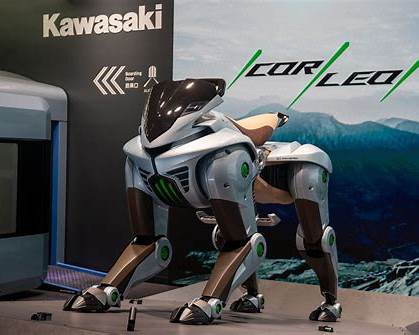
CORLEO’s most radical feature is its quadrupedal leg system. Each leg is independently powered and controlled, making it biomimetic — modeled after animals like mountain goats or horses.
- Swing-arm leg suspension mimics natural gait movement
- Rubber split hooves provide grip on slick or loose surfaces
- Weight-balanced walking adapts to staircases, boulders, and slopes
The suspension and balance system absorb impact and prevent rider fatigue, allowing for smooth, stable rides over surfaces that would immobilize wheeled vehicles.
This kind of adaptive movement is a direct evolution of technologies being explored in military, disaster response, and exploration robots like Boston Dynamics’ Spot or NASA’s legged Mars rovers.
Intuitive Rider Interface
Unlike motorcycles with throttles, clutches, and gear shifts, CORLEO is controlled primarily by body motion.
- Leaning forward initiates forward motion
- Shifting weight left or right triggers directional changes
- Handlebars and stirrups provide balance and support
CORLEO’s sensors track your center of gravity and balance, and its AI ensures you’re always upright and steady. It learns your riding posture, adjusting movement fluidly based on input and terrain.
This human-machine synergy marks a significant step forward in non-verbal robotic control — an emerging field where gesture, balance, and physical cues replace buttons and joysticks.
Real-World Use Cases: Why Kawasaki Corleo Redefines the Future of Two-Wheeled Mobility Matters
This isn’t just a tech demo. CORLEO has real potential to solve mobility problems in challenging environments.
Remote Rescue Operations
Imagine a hiker stranded in a mountain pass after a landslide. A wheeled vehicle can’t reach them. A drone might help locate them, but can’t carry supplies.
CORLEO can traverse the terrain, carry equipment, and even help extract the injured person, all without endangering rescuers.
Agricultural & Infrastructure Work
In rural Japan, U.S. ranches, or developing regions with limited roads, CORLEO can:
- Inspect irrigation lines
- Monitor wildlife fencing
- Haul small loads across uneven pastures
It opens up safer, cleaner solutions in off-road logistics and precision agriculture.
Eco-Tourism and Park Patrols
National parks and UNESCO World Heritage sites often ban vehicles to protect the environment. CORLEO offers zero-emission mobility that leaves no tracks or tire ruts, ideal for:
- Park rangers on patrol
- Guided adventure tours
- Wildlife researchers in remote locations
Competitive Context: How Does CORLEO Compare?
While the concept of legged mobility isn’t entirely new, CORLEO is the first hydrogen-powered, rideable robot aimed at personal use.
Boston Dynamics built the famous “Spot” robot — but it’s not rideable. Yamaha’s MOTOROiD experiments with balance, but still has wheels. CORLEO is one of the first major consumer-oriented machines that combines robotics, hydrogen energy, and rider integration.
Kawasaki isn’t trying to compete with Tesla or Harley-Davidson — they’re creating a new market niche entirely. That’s a power move in a mobility space that’s ripe for disruption.
How This Fits into Kawasaki’s 2050 Vision?
Kawasaki’s larger vision includes:
- Carbon neutrality by 2050
- Personal mobility solutions for aging and remote populations
- Multi-modal transport systems including robots, drones, and EVs
CORLEO is just one concept in a suite of human-centered mobility innovations to be showcased at Expo 2025 Osaka. It’s both an engineering prototype and a public messaging vehicle for Kawasaki’s brand evolution.
Practical Considerations On Kawasaki Corleo Redefines the Future of Two-Wheeled Mobility
Availability
CORLEO is a concept vehicle, not in production. Kawasaki has not committed to a consumer release, but interest and feasibility testing at Expo 2025 could shape its future.
Speed & Range
Exact specs are under wraps, but given hydrogen’s energy density, expect multi-hour operational capability — likely suited for mid-speed traversal (10–25 mph), not racing.
Learning Curve
Despite its advanced tech, CORLEO is designed for accessibility. The body-based control system minimizes training time. If you can ride a horse or bicycle, you’ll adapt quickly.
This New Glue Is So Strong It Can Tow a Car; Scientists Say It Could Replace Welding
NASA Confirms 3 Million Tons of Lunar Fuel Could Power Earth for 400+ Years